

How do picking robots navigate in a warehouse?
Jul 28, 2025
Leave a message
Hey there! As a supplier of picking robots, I often get asked how these nifty machines navigate around a warehouse. It's a super interesting topic, and I'm stoked to share all the deets with you.
Let's start with the basics. Picking robots are designed to move around warehouses, find products, and pick them up for various tasks like order fulfillment. But how do they know where to go and what to do? Well, there are a few key methods they use.
One of the most common ways is through the use of maps. Just like we use maps on our phones to get around, picking robots have digital maps of the warehouse. These maps are created during the setup process. The engineers will use lasers and other sensors to scan the entire warehouse, creating a detailed 3D model. This model includes the location of shelves, aisles, and any obstacles. The robot then uses this map as a guide to navigate.
For example, let's say an order comes in for a specific product. The robot's system will look at the map, figure out where the product is located, and then plan a route to get there. It takes into account things like the shortest distance, the traffic in the aisles, and any areas that might be off - limits.
Another important aspect is the use of sensors. Picking robots are equipped with a variety of sensors that help them "see" and interact with their environment. There are laser scanners that can detect objects in front of the robot. These scanners send out laser beams and measure the time it takes for the beams to bounce back. Based on this information, the robot can determine the distance to an object and whether it needs to stop or change its path.
There are also cameras on the robots. Cameras can be used for a couple of different things. First, they can help the robot identify products. The robot's software is trained to recognize different shapes, colors, and labels of products. So when it gets to a shelf, it can use the camera to find the right item. Second, cameras can be used for navigation. They can detect landmarks in the warehouse, like signs or unique features on the walls. By constantly comparing what the camera sees to the map, the robot can stay on track.
Some of our picking robots, like the Cantilever Robot, are really advanced in terms of sensor technology. It has a high - precision laser scanner that can detect even the smallest obstacles, and its cameras have a wide field of view, which helps it quickly identify products and navigate complex warehouse layouts.
In addition to maps and sensors, picking robots also use algorithms to make decisions. These algorithms are like the brain of the robot. They take all the information from the sensors and the map and decide the best course of action. For example, if the robot encounters an unexpected obstacle in the aisle, the algorithm will quickly calculate a new route to avoid it.
There are different types of algorithms used in picking robot navigation. One type is path - planning algorithms. These algorithms are responsible for finding the best route from the robot's current position to the destination. They consider factors like distance, speed, and the availability of paths. Another type is collision - avoidance algorithms. These algorithms constantly monitor the robot's surroundings and make sure it doesn't run into anything.
Now, let's talk about communication. Picking robots don't work in isolation. They need to communicate with other robots in the warehouse, as well as with the central control system. This communication is crucial for efficient operation.
The robots use wireless communication protocols to exchange information. For example, they can share their current location, their destination, and any issues they encounter. This way, other robots can adjust their routes to avoid congestion. The central control system also plays a big role. It can send commands to the robots, like assigning new tasks or rerouting them based on changes in the warehouse.
Our 3D Vision Robot is a great example of a robot that benefits from seamless communication. It can communicate with other robots in real - time, which allows it to work in harmony with the rest of the fleet and complete tasks more efficiently.
Some warehouses also use a concept called "swarm intelligence" in robot navigation. In a swarm - based system, the robots work together like a colony of ants. Each robot doesn't need to have a complete understanding of the entire warehouse. Instead, they follow simple rules and interact with their neighbors. For example, if one robot finds a shortcut, it can share this information with other robots in the area. This way, the whole group can benefit from the discovery.
Let's not forget about the role of artificial intelligence (AI) in picking robot navigation. AI allows the robots to learn and adapt over time. As the robots move around the warehouse, they collect data about their environment, such as the frequency of traffic in different aisles, the time it takes to pick certain products, and the behavior of other robots.
The AI algorithms analyze this data and use it to improve the robot's performance. For example, if the robot notices that a particular aisle is always congested at a certain time of the day, it can learn to avoid that aisle during those hours. Our Palletizing Robot uses AI to optimize its picking and placing operations, which also affects its navigation as it moves between storage areas and palletizing stations.
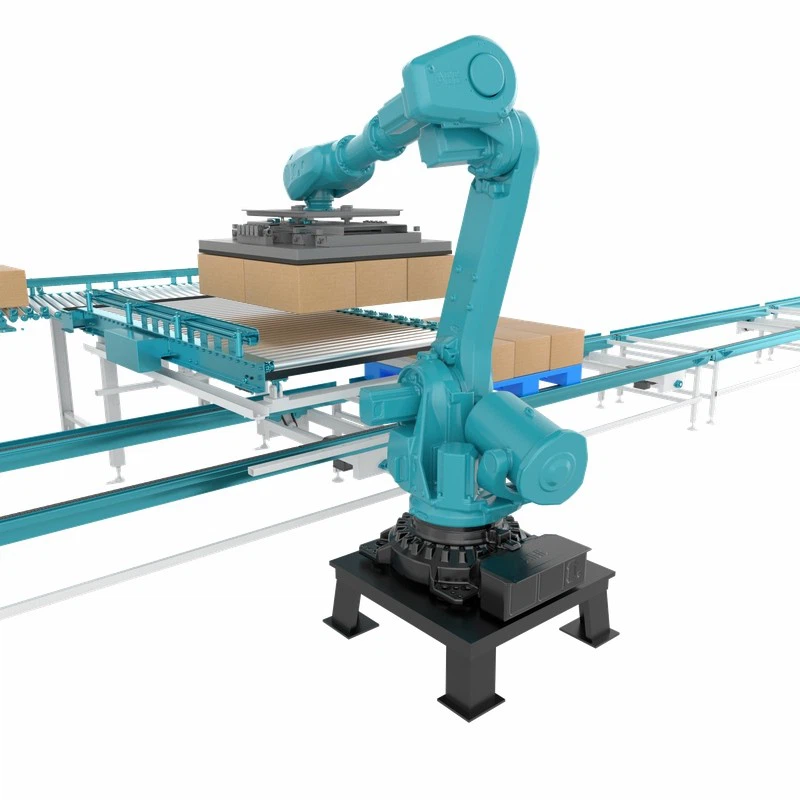

As you can see, picking robot navigation is a complex but fascinating process. It combines maps, sensors, algorithms, communication, and AI to ensure that the robots can move around the warehouse safely and efficiently.
If you're running a warehouse and are thinking about upgrading your operations with picking robots, we'd love to have a chat. Whether you're dealing with a small - scale warehouse or a large - scale distribution center, our range of picking robots can be customized to meet your specific needs. We can help you set up the system, train your staff, and provide ongoing support. So, don't hesitate to reach out and start a conversation about how our picking robots can transform your warehouse operations.
References
- "Automated Guided Vehicles and Mobile Robots" by O. Kaynak
- "Warehouse Automation: Technologies and Applications" by M. R. G. van der Heijden