

How do robots use computer vision to perceive the environment?
Jun 06, 2025
Leave a message
As a robot supplier, I've witnessed firsthand the transformative power of computer vision in enabling robots to interact with the world around them. Computer vision equips robots with the ability to "see" and understand their environment, which is crucial for a wide range of applications, from industrial automation to service and exploration tasks. In this blog, I'll delve into how robots use computer vision to perceive the environment and highlight the benefits this technology brings to our offerings.

How Computer Vision Works in Robots
At its core, computer vision for robots is about mimicking human vision to some extent, but with the precision and repeatability that machines can offer. The process generally involves several key steps: image acquisition, pre - processing, feature extraction, and object recognition.
Image Acquisition
Robots use various types of sensors to capture images of their surroundings. Cameras are the most common, including RGB (Red, Green, Blue) cameras that capture color images, and depth cameras such as Time - of - Flight (ToF) cameras or stereo cameras. ToF cameras measure the time it takes for light to travel to an object and back, enabling the robot to create a 3D map of the environment. Stereo cameras, on the other hand, work like human eyes, using two lenses to capture slightly different views of the same scene, from which depth information can be calculated.
Pre - processing
Once the images are captured, they often need to be pre - processed to improve the quality and make them easier to analyze. This can involve tasks such as noise reduction, image enhancement, and resizing. Noise reduction algorithms, like Gaussian filtering, can remove random noise from the image, which might be caused by sensor limitations or environmental factors. Image enhancement techniques, such as histogram equalization, can improve the contrast of the image, making objects more distinguishable.
Feature Extraction
Feature extraction is a critical step where the robot identifies important elements in the image. These features can be edges, corners, or blobs. For example, the Harris corner detector is a popular algorithm for detecting corners in an image. By finding these features, the robot can start to understand the structure of the objects in its environment. In more advanced scenarios, deep learning - based feature extraction methods, such as Convolutional Neural Networks (CNNs), are used. CNNs can automatically learn complex features from large amounts of training data, making them very effective at handling a wide variety of objects and scenes.
Object Recognition
After feature extraction, the robot uses the extracted features to recognize objects in the image. This can be done through template matching, where the robot compares the extracted features with a set of pre - defined templates of known objects. More commonly today, deep learning models are used for object recognition. These models are trained on large datasets containing thousands or even millions of images of different objects. Once trained, they can accurately classify objects in new images, even in different orientations, lighting conditions, and partial occlusions.
Applications of Computer Vision in Our Robots
Our company offers a diverse range of robots, each leveraging computer vision in unique ways to perform specific tasks.
Palletizing Robot
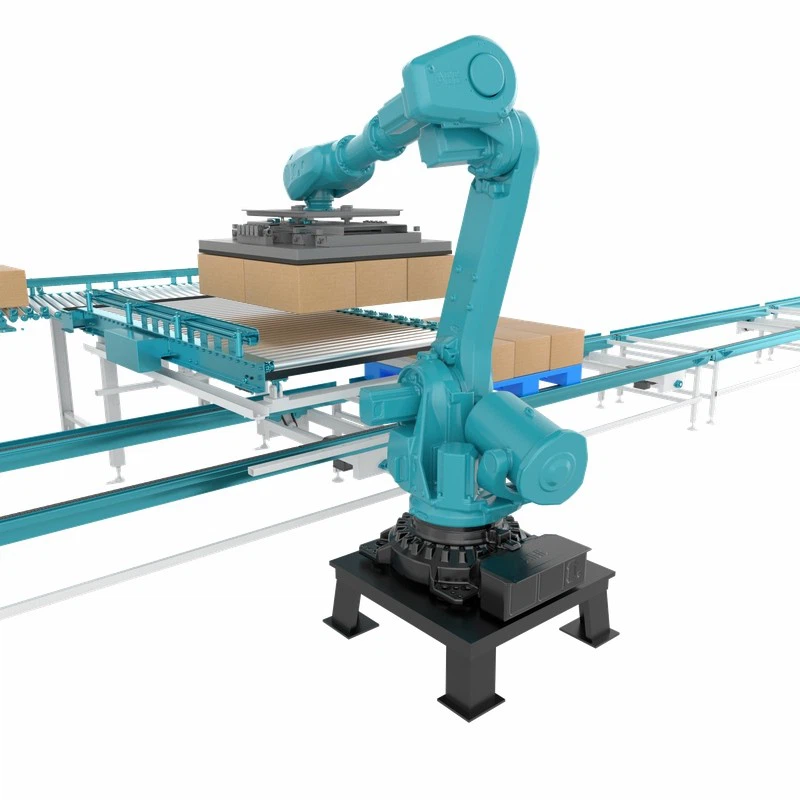
Palletizing robots are used in warehouses and manufacturing plants to stack products onto pallets. Computer vision plays a vital role in this process. The robot uses its vision system to identify the position and orientation of the products on the conveyor belt. It can then calculate the best way to pick up the products and place them on the pallet in an organized manner. The vision system also helps the robot adapt to different product sizes and shapes, ensuring accurate and efficient palletizing.
Picking Robot
Picking robots are designed to pick items from shelves or bins in a warehouse. With computer vision, these robots can quickly and accurately identify the target items. The vision system can detect the location, size, and shape of the items, allowing the robot to plan the best approach for picking. This is especially important in e - commerce fulfillment centers, where a large variety of products need to be picked and packed in a short time.
Cantilever Robot
Cantilever robots are often used in applications where a large working area needs to be covered. Computer vision enables these robots to navigate their environment safely. The robot can use its vision system to detect obstacles, such as other equipment or workers, and plan a collision - free path. Additionally, in tasks such as inspection, the vision system can help the robot identify defects or irregularities on the surface of the objects it is working with.
Benefits of Computer Vision - Enabled Robots
The integration of computer vision into our robots brings several significant benefits.
Increased Efficiency
Computer vision allows robots to perform tasks more quickly and accurately. For example, in the case of palletizing and picking robots, the ability to precisely identify objects reduces the time spent on searching and handling, leading to higher throughput in warehouses and manufacturing facilities.
Flexibility
Robots with computer vision can adapt to different environments and tasks. They can handle a variety of objects without the need for extensive reprogramming. This makes them suitable for industries with rapidly changing product lines or requirements.
Safety
In industrial settings, safety is of utmost importance. Computer vision helps robots detect and avoid collisions with humans and other objects. This reduces the risk of accidents and ensures a safer working environment.
Contact Us for a Purchase Consultation
If you're interested in enhancing your operations with our computer - vision - enabled robots, we'd love to hear from you. Our team of experts can provide in - depth information about our products, including the Palletizing Robot, Picking Robot, and Cantilever Robot. We can also help you determine the best solution for your specific needs, whether it's improving efficiency in your warehouse or enhancing the quality control in your manufacturing process. Reach out to us for a detailed consultation and let's take your business to the next level together.
References
Ballard, D. H., & Brown, C. M. (1982). Computer Vision. Prentice - Hall.
Goodfellow, I. J., Bengio, Y., & Courville, A. (2016). Deep Learning. MIT Press.
Szeliski, R. (2010). Computer Vision: Algorithms and Applications. Springer.